.jpg)

Effect of Blood and Saliva Contamination on the Shear Bond Strength of 6th, 7th and 8th Generation Bonding Agents – An in Vitro Study
Neha Sandra Vincent1  , Duddi Narendra Nirupama2* and Mohan Nainan Thomas 2
1Private Practioner , Bangalore, Karnataka India .
2Department of Conservative Dentistry and Endodontics, Vydehi Institute of Dental Sciences and Research Centre , Whitefield, Bangalore, Karnataka India .
http://dx.doi.org/10.12944/EDJ.08.0106
To evaluate the effect of saliva and blood contamination on the shear bond strength of 6th, 7th, and 8th generation bonding agents.Seventy-two non-carious human mandibular molars were embedded in self-cure acrylic resin and flattened to expose dentin. The specimens were divided into three adhesive groups: Clearfil SE Protect (6th gen), Tokuyama Palfique Bond (7th gen), and G-Bond Premio (8th gen). Each group was further subdivided into three subgroups: control, contamination before curing, and contamination after curing (n = 8 each). Contaminants (fresh saliva and blood mixture) were applied using a micro-brush as per protocol. Composite cylinders (3 mm × 5 mm) were built and light-cured for 20 seconds. After 24 hours of storage in saline at 37 °C, specimens were tested for shear bond strength (SBS) using an Instron Universal Testing Machine at 1 mm/min. Data were analyzed by one-way ANOVA and Tukey’s post-hoc test.The 6th generation adhesive (Clearfil SE Protect) showed the highest mean SBS (24.66 ± 0.96 MPa) under control conditions, followed by the 7th generation (22.85 ± 1.01 MPa) and 8th generation (21.61 ± 1.19 MPa). Contamination before curing resulted in the greatest reduction in SBS (p < 0.001). No statistically significant difference was found when contamination occurred after curing (p = 0.22).Saliva and blood contamination significantly reduce dentin shear bond strength, especially when contamination occurs prior to adhesive curing. The two-step self-etch (6th generation) adhesive demonstrated superior performance under contamination conditions. Proper isolation remains critical in adhesive restorative procedures.
Copy the following to cite this article:
Vincent N. S, Nirupama D. N, Nainan M. T. Effect of Blood and Saliva Contamination on the Shear Bond Strength of 6th, 7th and 8th Generation Bonding Agents – An in Vitro Study. Enviro Dental Journal 2026;8(1).
DOI:http://dx.doi.org/10.12944/EDJ.08.0106Copy the following to cite this URL:
Vincent N. S, Nirupama D. N, Nainan M. T. Effect of Blood and Saliva Contamination on the Shear Bond Strength of 6th, 7th and 8th Generation Bonding Agents – An in Vitro Study. Enviro Dental Journal 2026;8(1).Available here: https://bit.ly/3RNfVFE
Download article (pdf) Citation Manager

Introduction
The success of adhesive dentistry relies on achieving a durable bond between resin composite and tooth structure. However, contamination with saliva or blood during restorative procedures remains a significant clinical challenge, particularly in cervical and subgingival areas.
While rubber dam isolation is the gold standard for moisture control, its use is not always practical in daily practice. To simplify clinical protocols, 7th- and 8th-generation bonding agents were introduced with fewer application steps. Yet, their higher hydrophilicity may increase susceptibility to contamination, potentially compromising bond strength.
Although prior studies have documented reductions in bond strength due to saliva or blood contamination, there is limited comparative evidence on how different modern adhesive generations perform under standardized contamination conditions.
This study aims to compare the shear bond strength of 6th-, 7th-, and 8th-generation adhesives following saliva or blood contamination applied before or after adhesive curing. Null hypothesis states that Contamination with saliva or blood has no effect on the shear bond strength of the tested adhesives.
Materials and Methods
Sample Preparation
Seventy-two freshly extracted, non-carious human mandibular molars were cleaned of debris and stored in normal saline until use. Each tooth was embedded in self-cure acrylic resin up to the cementoenamel junction, and the occlusal surface was flattened using 600-grit silicon carbide abrasive papers to expose dentin.
Groups:
Samples were randomly divided into three adhesive groups (n = 24 per group):
Group 1 - G-Bond Premio-8th Generation (one-step self-etch)
Group 2 - Tokuyama Palfique Bond-7th Generation (one-step self-etch)
Group 3 - Clearfil SE Protect-6th Generation (two-step self-etch)
Each adhesive group was subdivided into three subgroups (n = 8 each):
Condition 1– Control-No contamination, Adhesive applied and cured normally (no saliva/blood).
Condition 2 – Contamination before curing, Contaminant applied before adhesive curing a mixture of saliva and blood was applied to the dentin along with the uncured bonding agent, then light-cured together.
Condition 3–Contamination after curing, Contaminant applied after adhesive curing.The bonding agent was first cured, and saliva–blood mixture was then applied on the cured layer.
Contamination Protocol
Freshly collected human saliva and blood from a healthy donor were mixed in equal proportion. The mixture was applied using a micro-brush for 10 seconds, then gently blot-dried before adhesive application or after curing, as per subgroup design.
Bonding and Restoration Procedure
Each adhesive system was applied per manufacturer’s instructions. A composite resin (IvoclarTe-Econom Plus) was placed incrementally (3 mm × 5 mm mould) and light-cured for 20 seconds using a QHL-75 tungsten halogen curing light (600 mW/cm²). Samples were stored in distilled water at 37 °C for 24 hours.
Shear Bond Strength Testing
Shear bond strength was measured using an Instron Universal Testing Machine at a cross-head speed of 1.0 mm/min until failure. The maximum load at failure was recorded in Newtons and converted to MPa.
Statistical Analysis
The collected data were subjected to statistical evaluation using one-way ANOVA followed by Tukey’s post-hoc comparison to identify intergroup differences.
Results
The highest mean shear bond strength values were observed for Clearfil SE Protect (6th gen) under all conditions. Contamination before curing caused the most significant reduction in bond strength (p < 0.001). No significant difference was observed between adhesives when contamination occurred after curing (p = 0.22).( Table 1& 2 , Graph 1 & 2 )
Table 1: Comparison of Mean Shear Bond Strength ( MPA) Between Different Groups
CONDITIONS | GROUPS | N | MEAN | SD | P VALUEa | SIG . DIFF | P VALUEb |
CONDITION 1 | GROUP 1 | 8 | 21.61 | 1.19 | < 0.001 * | G1 VS G2 | 0.07 |
GROUP 2 | 8 | 22.85 | 1.01 | G1 VS G3 | < 0.001 * | ||
GROUP 3 | 8 | 24.66 | 0.96 | G2 VS G3 | 0.007* | ||
CONDITIONS 2 | GROUP 1 | 8 | 18.89 | 0.13 | < 0.001 * | G1 VS G2 | 0.04* |
GROUP 2 | 8 | 19.71 | 0.76 | G1 VS G3 | < 0.001 * | ||
GROUP 3 | 8 | 21.07 | 0.84 | G2 VS G3 | < 0.001 * | ||
CONDITIONS 3 | GROUP 1 | 8 | 18.39 | 0.98 | 0.22 | G1 VS G2 | -- |
GROUP 2 | 8 | 18.56 | 1.07 | G1 VS G3 | -- | ||
GROUP 3 | 8 | 19.40 | 1.47 | G2 VS G3 | -- |
*Statistically significant
Table 2: Comparison of Mean Shear Bond Strength (MPA) Between Different Conditions In Each Group.
GROUPS | CONDITIONS | N | MEAN | SD | P VALUEa | SIG . DIFF | P VALUEb |
GROUP 1 | CONDITIONS 1 | 8 | 21.61 | 1.19 | < 0.001 * | G1 VS G2 | < 0.001 * |
CONDITIONS 2 | 8 | 18.89 | 1.03 | G1 VS G3 | < 0.001 * | ||
CONDITIONS 3 | 8 | 18.39 | 0.98 | G2 VS G3 | 0.52 | ||
GROUP 2 | CONDITIONS 1 | 8 | 22.85 | 1.01 | < 0.001 * | G1 VS G2 | < 0.001 * |
CONDITIONS 2 | 8 | 19.71 | 0.76 | G1 VS G3 | < 0.001 * | ||
CONDITIONS 3 | 8 | 18.56 | 1.07 | G2 VS G3 | 0.04 * | ||
GROUP 3 | CONDITIONS 1 | 8 | 24.66 | 0.96 | 0.22 | G1 VS G2 | < 0.001 * |
CONDITIONS 2 | 8 | 21.07 | 0.84 | G1 VS G3 | < 0.001 * | ||
CONDITIONS 3 | 8 | 19.40 | 1.47 | G2 VS G3 | 0.02 * |
*Statistically significant
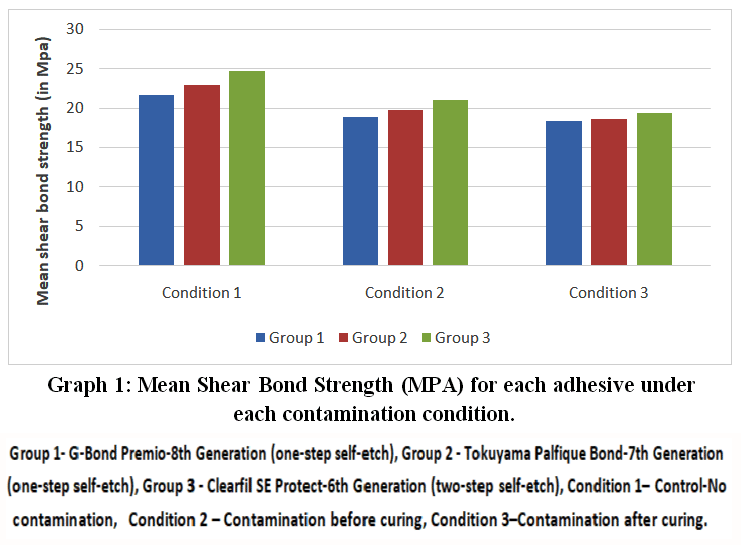 | Graph 1: Mean Shear Bond Strength (MPA) for each adhesive under each contamination condition.
|
Group 1 - Bond Premio-8th Generation (one-step self-etch), Group 2 - Tokuyama Palfique Bond-7th Generation (one-step self-etch), Group 3 - Clearfil SE Protect-6th Generation (two-step self-etch), Condition 1– Control-No contamination, Condition 2 – Contamination before curing, Condition 3–Contamination after curing.significant at p < 0.05
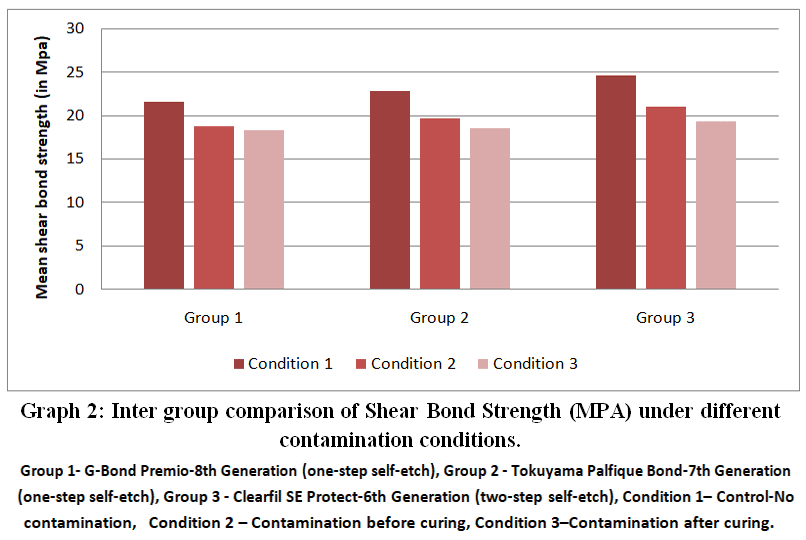 | Graph 2: Inter group comparison of Shear Bond Strength (MPA) under different contamination conditions.
|
Group 1- G-Bond Premio-8th Generation (one-step self-etch), Group 2 - Tokuyama Palfique Bond-7th Generation (one-step self-etch), Group 3 - Clearfil SE Protect-6th Generation (two-step self-etch), Condition 1– Control-No contamination, Condition 2 – Contamination before curing, Condition 3–Contamination after curing.
Discussion
The present study evaluated and compared the effect of saliva and blood contamination on the shear bond strength (SBS) of 6th, 7th, and 8th generation dentin bonding agents. Bonding efficiency to tooth structure is a critical determinant of restorative success, influencing both marginal integrity and the long-term durability of composite restorations.1,2 Despite significant advances in adhesive formulations, achieving and maintaining a dry operating field continues to be one of the greatest clinical challenges—particularly in Class II cavities, deep cervical margins, and subgingival areas where access and visibility are limited.
In clinical settings, contamination of prepared dentin surfaces by saliva or blood is almost inevitable. Saliva contamination may occur during procedures in the posterior region or when rubber dam isolation is compromised.3 Blood contamination is especially likely during restorative treatment of deep Class II or Class V lesions near the gingival margin, following gingival retraction, or after trauma to soft tissues.4 Saliva contains mucins and glycoproteins that form an acquired pellicle within seconds, reducing surface energy and preventing proper adhesive wetting.11,12 Blood, being thicker and richer in proteins such as fibrinogen and albumin, creates a tenacious film that hinders resin monomer infiltration and polymerization.7,14
Earlier studies have consistently shown that the presence of these contaminants compromises the quality of hybrid layer formation and weakens micromechanical retention.5,6,9 Since saliva and blood represent the most common and clinically relevant contaminants encountered during bonding, their inclusion in this study provides realistic insight into the adhesive performance of current systems under non-ideal conditions.1,2,6,7
The 6th, 7th, and 8th generation bonding agents were selected for comparison because they represent successive technological evolutions in adhesive dentistry, each incorporating different chemistry and application protocols.2,5,8
Sixth-generation adhesives are two-step self-etch systems where the primer and adhesive are applied separately. This approach ensures adequate infiltration of hydrophilic monomers into demineralized dentin; however, it is technique-sensitive and highly dependent on correct solvent evaporation and dentin moisture control.9
Seventh-generation systems simplified this process by combining the primer and adhesive into a single application step, marketed as “one-bottle self-etch adhesives.” Although easier to use, these materials are more hydrophilic and may absorb water over time, potentially compromising the bond interface.3,8,10
Eighth-generation adhesives represent the latest development, incorporating nano-fillers, functional monomers such as 10-MDP, and solvents designed for improved penetration into moist dentin. Their formulations aim to enhance tolerance to contamination and reduce technique sensitivity.2,5,8
Comparing these three generations allows an objective evaluation of whether recent advances in chemistry and formulation have successfully overcome the limitations of earlier systems, especially when bonding conditions are less than ideal. Previous studies have reported that newer universal or multimode adhesives often exhibit higher bond strengths under contaminated conditions compared to earlier generations.2,5,7,8Thus, this comparison is essential for identifying adhesives that perform reliably when perfect isolation cannot be achieved clinically.
The shear bond strength test is one of the most widely used and standardized in-vitro methods for evaluating the bonding efficiency of adhesive systems.4 It measures the amount of force required to break the adhesive joint under shear stress, which closely simulates the stresses encountered at the tooth–restoration interface during mastication and occlusal loading.12
SBS testing provides quantitative data that allow comparisons between different bonding systems, surface conditions, and contamination scenarios. It is a simple, reproducible, and sensitive method that correlates well with the mechanical integrity of the hybrid layer and resin–dentin interface.4,11 Although alternative tests such as microtensile bond strength have also been used, the SBS test remains the preferred choice for comparative studies because it requires simpler specimen preparation, has less technique variability, and produces clinically interpretable results.3,12
In this study, SBS testing provided a consistent means of assessing the influence of saliva and blood contamination on the adhesive performance of each generation of bonding agents, thereby allowing meaningful comparison of results.
Class II restorations often present the greatest challenge in adhesive dentistry due to the frequent location of gingival margins below the cementoenamel junction (CEJ). In these cases, bonding occurs primarily to dentin or cementum,which have higher organic content and less mineralized substrate compared to enamel. Moreover, subgingival margins are difficult to isolate, predisposing them to saliva and blood contamination during restorative procedures.13
Contamination at the adhesive interface in Class II restorations can compromise polymerization, reduce bond strength, and result in microleakage, postoperative sensitivity, marginal discoloration, and secondary caries.13,15 Because of these clinical risks, evaluating adhesive performance under contamination helps clinicians choose the most reliable materials and adopt protocols that minimize restoration failure.
Blood contamination is particularly detrimental to cervical margins of Class II cavities where slight gingival bleeding may occur. The results of the present study demonstrated that blood contamination led to the lowest SBS values among all conditions, consistent with findings from previous research.7,14,17 Saliva contamination produced a less pronounced but still significant reduction in bond strength, in agreement with studies by Chaudhari et al. and Cobanoglu et al.3,4
Among the materials tested, the 6th-generation adhesive showed the highest mean SBS values under both contaminated and uncontaminated conditions. This can be attributed to the improved chemical formulation, presence of functional monomers with strong dentin interaction, and enhanced wetting ability that promotes better penetration into partially moist substrates.2,5,8 The superior tolerance of newer adhesives to contamination suggests that simplified, nanofilled, and universal bonding agents may offer clinical advantages in challenging restorative scenarios where perfect isolation cannot be achieved.
Despite these encouraging findings, none of the bonding agents were completely immune to the negative influence of saliva and blood. This reinforces the importance of maintaining adequate isolation, using re-etching or adhesive reapplication when contamination occurs, and following strict clinical protocols for successful bonding.9,10,17,18
The rationale for this study was to reproduce the contamination conditions most commonly encountered in clinical practice and to evaluate whether newer adhesive generations can maintain bond integrity under such circumstances. Saliva and blood were chosen as contaminants because of their clinical relevance and distinct interference mechanisms. The 6th, 7th, and 8th generation bonding agents were compared to assess the progression of adhesive technology toward improved contamination resistance. The shear bond strength test was employed as a reliable and standardized measure of the adhesive interface’s mechanical integrity.
Understanding how these variables interact is especially important for Class II restorations, where achieving a perfect seal is essential for preventing marginal leakage and failure. The findings of this study therefore provide valuable guidance for selecting appropriate adhesive systems and implementing contamination-control strategies in everyday restorative practice.1–4,6–10,13–20
Limitations
In-vitro conditions may not fully replicate oral dynamics.
Thermocycling or aging was not included to assess long-term durability.
Conclusion
Contamination with saliva or blood significantly compromises the shear bond strength of adhesives, particularly when it occurs before curing. Among the materials tested, Clearfil SE Protect showed superior tolerance to contamination compared to other generations. These findings reinforce the need for strict isolation and moisture control in adhesive dentistry.
Acknowledgement
I sincerely thank Rajiv Gandhi University of Health Sciences (RGUHS), Bengaluru, for their valuable support.
Funding Sources
Rajiv Gandhi University of Health Sciences Research Grant (Project Code: UG22DEN163) that made this study possible.
Conflict of Interest
The authors do not have any conflict of interest
Data Availability Statement
This statement does not apply to this article.
Ethics Statement
This research did not involve human participants, animal subjects, or any material that requires ethical approval
Informed Consent Statement
This study did not involve human participants, and therefore, informed consent was not required.
Permission to reproduce material from other sources:
Not applicable
Clinical Trial Registration
This research does not involve any clinical trials.
Authors Contributions
• Neha Sandra Vincent: Writing – Original Draft.
•Duddi Narendra Nirupama: Conceptualization, Methodology, Analysis, Writing – Review & Editing.
• Mohan Thomas Nainan: Review, Supervision.
References
- Koppolu M, Gogala D, Mathew VB, Thangala V, Deepthi M, Sasidhar N. Effect of saliva and blood contamination on the bond strength of self-etching adhesive system: An in vitro study. J Conserv Dent. 2012;15(3):270-273.
CrossRef - Taneja S, Kumari M, Bansal S. Effect of saliva and blood contamination on the shear bond strength of fifth-, seventh- and eighth-generation bonding agents: An in vitro study. J Conserv Dent. 2017;20(3):157-160.
CrossRef - Chaudhari RR, et al. Effect of Saliva Contamination on Shear Bond Strength of a Self-Etch Adhesive System to Dentin. J Conserv Dent. 2021;24(6):602-606.
CrossRef - Cobanoglu N, et al. Bond Strength of Self-etch Adhesives After Saliva Contamination at Different Bond Application Steps. Oper Dent. 2013;38(5):505-511.
CrossRef - Bolmé J, et al. Effect of Saliva Contamination on Bond Strength to Dentin with Etch-and-Rinse and Self-Etch Adhesive Systems. Eur J Oral Sci. 2022;130:e12838.
- Sattabanasuk V, Shimada Y, Tagami J. Effects of saliva contamination on dentin bond strength using all-in-one adhesives. J Adhes Dent. 2006;8(5):311-318.
- Küçükyilmaz E, et al. Influence of blood contamination during multimode adhesive application on microtensile bond strength to dentin. Niger J ClinPract. 2017;20(12):1644-1650.
CrossRef - Hegde MN, Hegde P, Shetty SK. Influence of salivary contamination on the shear bond strength of newer generation dentin bonding agents. J Conserv Dent. 2008;11(3):127-130.
CrossRef - Abdalla AI, Davidson CL. Bonding efficiency and interfacial morphology of one-bottle adhesives to contaminated dentin surfaces. Am J Dent. 1998;11(6):281-285.
- El-Kalla IH, García-Godoy F. Saliva contamination and bond strength of single-bottle adhesives to enamel and dentin. Am J Dent. 1997;10(2):83-87.
- Fritz UB, Finger WJ, Stean H. Salivary contamination during bonding procedures with a one-bottle adhesive system. Quintessence Int. 1998;29(9):567-572.
- Yoo HM, Oh TS, Pereira PN. Effect of saliva contamination on the microshear bond strength of one-step self-etching adhesive systems to dentin. Oper Dent. 2006;31(1):127-134.
CrossRef - Dietrich T, Krämer M, Lösche GM, et al. Influence of dentin conditioning and contamination on marginal integrity of sandwich restorations. Oper Dent. 2000;25(5):401-410.
- Van Schalkwyk JH, Botha FS, de Wet FA. Effect of biological contamination on dentin bond strength of adhesive resins. SADJ. 2003;58:143-147.
- Ar? H, et al. Effect of artificial saliva contamination on bond strength to pulp chamber dentin. J Dent. 2008;36(8):660-665.
- Xie J, Powers JM, McGuckin RS. In-vitro bond strength of two adhesives to enamel and dentin under normal and contaminated conditions. Dent Mater. 1993;9(5):295-299.
CrossRef - Shaikh A, et al. Effect of blood contamination and decontamination procedures on microtensile bond strength of a new adhesive. Int J Esthet Dent. 2020;15(4):412-418.
- HegerunerSiso S, et al. Effect of decontamination protocols on recovery of adhesion to contaminated surfaces. J AdhesSci Technol. 2023;37(1):48-58.
- Mohan MC, Geetha P, Soman D, Kunjusankaran RN, Kurup NB, Venugopal K. The effect of salivary contamination on the shear bond strength of seventh-and eighth-generation adhesive systems. International Journal of Clinical Pediatric Dentistry. 2023 Aug;16(Suppl 1):S63.
CrossRef - Talesara K, Bhat N, Puri S, Sharma A, Srishti S. The influence of the salivary contamination on the shear bond strength of 6th and 7th generation dentin bonding agents: An invitro study. International Journal of Health Sciences. 2022 May 22(I):11228-37.
CrossRef